
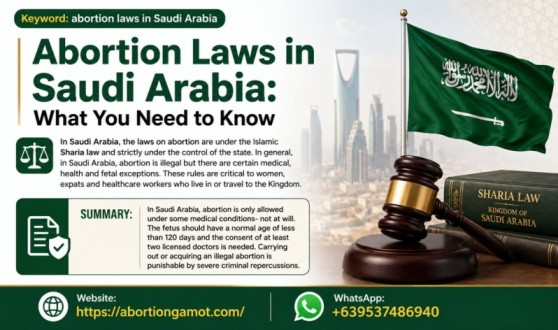
In Saudi Arabia, the laws on abortion are under the Islamic Sharia law and strictly under the control of the state. In general, in Saudi Arabia, abortion is illegal but there are certain medical, health and fetal exceptions. These rules are critical to women, expats and healthcare workers who live in or travel to the Kingdom.
Summary: In Saudi Arabia, abortion is only allowed under some medical conditions- not at will. The fetus should have a normal age of less than 120 days and the consent of at least two licensed doctors is needed. Carrying out or acquiring an illegal abortion is punishable by severe criminal repercussions. |
The question is, Is Abortion Legal in Saudi Arabia?
The terse is: No – not at will or on command. Saudi Arabia neither allows elective or choice-based abortion at any point in the pregnancy.
But the law, which is based on the Resolution No. 140 (dated 20 Jumada al-Akhirah, 1407H) of the Council of Senior Scholars (Hay’at Kibar al-Ulama) does permit abortion under narrowly defined medical and health-related conditions, subject to strict conditions.
The official Women Empowerment portal (my.gov.sa) of Saudi Arabia states that abortion is only allowed in those cases where the pregnancy poses a danger to the physical or mental health of the mother and where the fetus is younger than 120 days old, and two specialist physicians sign the decision.
Abortion Laws in Saudi Arabia: Legal Grounds & Conditions
The rules on abortion in Saudi Arabia are classified according to the gestation periods. The following gives a clear break down of what the law will permit:
Gestational Stage | Legal Status | Conditions |
0 – 40 days | Permissible with strict justification | Must show legitimate medical necessity or risk of significant harm. Economic reasons are explicitly prohibited. |
40 – 120 days (Embryo stage) | Allowed only in medical emergencies | An approved medical committee must confirm that continuation endangers the mother’s life or health, and all other options have been exhausted. |
After 120 days (Ensoulment) | Extremely restricted / near total prohibition | Permitted only if specialists confirm continued pregnancy will cause the mother’s death and all alternatives are exhausted. |
Authorized Lawful Reasons (Summary)
• Danger to the life of the mother- the first and the most obvious reason.
• Extreme physical health danger – reported by a medical committee.
Serious mental health risk (including pregnancy due to rape or incest (under the mental health exemption)
• Severe fetal impairment – where the fetus has been found with a fatal or a severe abnormality.
Caution: It is illegal to abort due to social or economic factors, such as not being able to raise a child or not being able to afford to send the child to school or not because the parents already have enough children.
The Islamic Law System Underlying the Saudi Arabia Law on Abortion
The legal system of Saudi Arabia is based on the Islamic Sharia, which is mostly followed by the Hanbali school of jurisprudence that is the strictest of the four major Sunni schools. Nonetheless, the Hanbali school never had its own single position regarding abortion and many Hanbali scholars in the past allowed termination before 120 days under special conditions.
The 120-Day “Ensoulment” Rule
One of the key ideas of Islamic jurisprudence is ensoulment – the point in time when a fetus is thought to acquire a soul. The number 120 days (four lunar months) is widely cited by scholars as this number, which was based on a Hadith of the Prophet Muhammad (PBUH). Once ensouled, abortion becomes tantamount to depriving a human being of life, thus, essentially, abhorrent to do so.
Views of Other Islamic Schools
• Hanafi & Shafi’i: Allow abortion under certain circumstances before ensoulment
• Maliki: The most conservative school – does not allow abortion at any point.
• Hanbali: It allows termination prior to 120 days when of grave necessity.
Legal Abortion in Saudi Arabia Medical & Procedural Requirements
Although abortion may be legally acceptable in certain countries, Saudi law dictates that procedures to be followed are very strict. They are described in the Ministerial Resolution No. 218/17/L (June 26, 1989) of the Ministry of Health.
1. physician examination: At least two practitioners who are licensed specialists doctors should verify the medical necessity.
2. Medical committee approval: It has to be approved by formally established medical committee, which must deliberate a written decision in favor of the procedure.
3. Guardian consent: According to the guardianship system (Mahram) of Saudi Arabia, a male guardian (usually a husband or father) must provide consent in order to have the procedure performed.
4. Accredited facility: It should be performed in an accredited hospital or other medical facility by the qualified personnel.
5. Documentation: Decision and approvals must be well documented in accordance to the hospital and ministry of health regulations.
Medical Note: According to the World Health Organization (WHO), unsafe abortion is one of the leading preventable causes of maternal death worldwide. It is important to seek care only by licensed medical experts and approved facilities in Saudi Arabia. In case of a health crisis in the course of pregnancy, call a licensed hospital or the helpline of Saudi Ministry of Health immediately. Illegal procedures are dangerous not only in their health implications but also in the legal repercussions of such actions. |
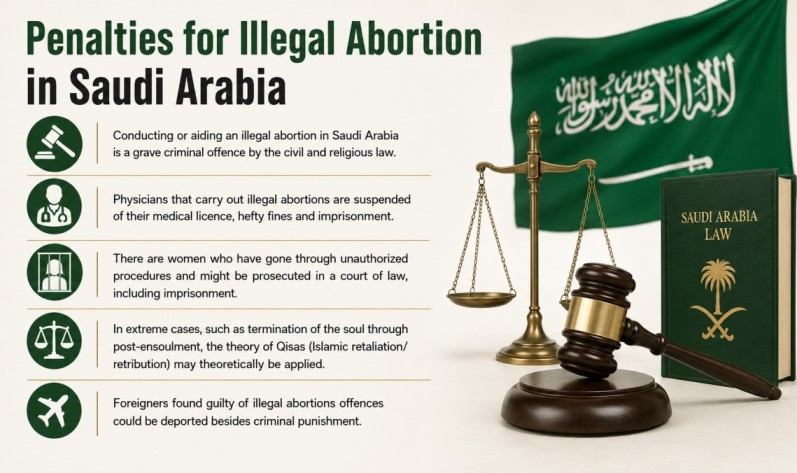
Penalties for Illegal Abortion in Saudi Arabia
Conducting or aiding an illegal abortion in Saudi Arabia is a grave criminal offence by the civil and religious law.
Physicians that carry out illegal abortions are suspended of their medical licence, hefty fines and imprisonment.
There are women who have gone through unauthorized procedures and might be prosecuted in a court of law, including imprisonment.
In extreme cases, such as termination of the soul through post-ensoulment, the theory of Qisas (Islamic retaliation/retribution) may theoretically be applied.
Foreigners found guilty of illegal abortions offences could be deported besides criminal punishment.
Saudi Arabia vs the MENA Region Abortion Laws
However, contrary to what many may believe, the framework of abortion in Saudi Arabia is relatively more lenient than some of the regional neighbours. The US-based Centre for Reproductive Studies says that Saudi Arabia is home to some of the most liberal abortion laws in the Middle East and North Africa (MENA) region.
Country | Abortion Availability |
Saudi Arabia | Limited — health, life, fetal impairment, rape/incest (via mental health clause) |
Turkey | Elective abortion permitted up to 10 weeks |
Tunisia | Elective abortion permitted up to 12 weeks |
Egypt | Prohibited in almost all circumstances |
Iraq | Prohibited even to save the mother’s life in many cases |
UAE | Permitted only to save the mother’s life or in cases of fetal abnormality |
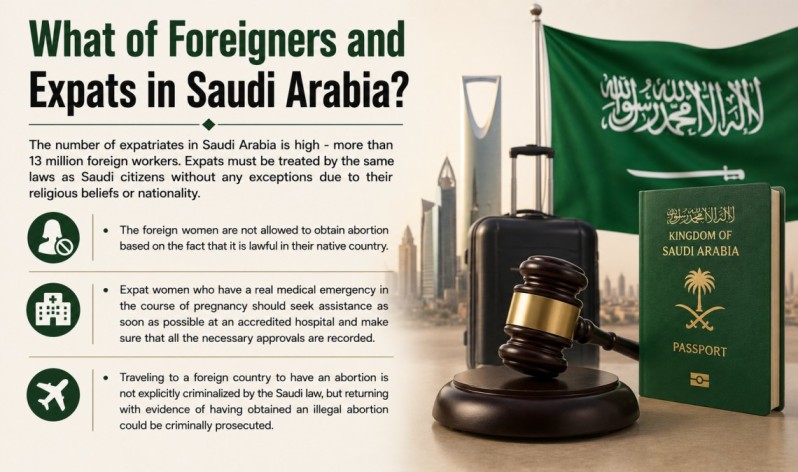
What of Foreigners and Expats in Saudi Arabia?
The number of expatriates in Saudi Arabia is high – more than 13 million foreign workers. Expats must be treated by the same laws as Saudi citizens without any exceptions due to their religious beliefs or nationality.
• The foreign women are not allowed to obtain abortion based on the fact that it is lawful in their native country.
• Expat women who have a real medical emergency in the course of pregnancy should seek assistance as soon as possible at an accredited hospital and make sure that all the necessary approvals are recorded.
• Traveling to a foreign country to have an abortion is not explicitly criminalized by the Saudi law, but returning with evidence of having obtained an illegal abortion could be criminally prosecuted.
(FAQ): Abortion Laws in Saudi Arabia
Q1. Legality of abortion in Saudi Arabia?
No, not on demand. Generally, the practice of abortion in Saudi Arabia is illegal. Only under certain medical conditions – mainly to safeguard the life or health of the mother – before 120 days of pregnancy and with the consent of a licensed medical committee, is it permitted.
Q2. Is it possible that a woman may abort in case she has been raped in Saudi Arabia?
Yes, in limited circumstances. A pregnancy resulting due to rape or incest is eligible to abortion under the mental health exemption, so long as the fetus is less than 120 days old and suitable medical and legal consent is provided. This however is not an automatic right and needs to be formally approved.
Q3. In Saudi Arabia, what is the time limit of abortion?
The most important legal requirement is 120 days (four lunar months) – the ensoulment requirement of Islamic law. Abortion is only allowed following this stage when the life of the mother is directly, imminently threatened and all other medical interventions had failed.
Q4. What would be the consequences of illegal abortion in Saudi Arabia?
There are severe legal impacts on both the woman and the performing physician, including criminal charges, imprisonment, fines and loss of license. Deportation of foreign nationals can also be done. Qisas (retribution) can be used in extreme post-ensoulment cases, as defined by Sharia law.
Q5. In Saudi Arabia, does a woman need the permission of her husband to abort?
Yes. The Saudi Arabia’s Male Guardianship (Mahram) System is a procedure where a man who serves as the guardian, mostly the husband or father, gives consent prior to carrying out the procedure of abortion, provided that it does not constitute an emergency situation.
Q6. Are expats or foreign workers allowed to have an abortion in Saudi Arabia?
Expats are not excluded by the laws as Saudi nationals. No exceptions are made on nationality and religion basis. In case a medical emergency occurs in a pregnant foreigner, the doctor should take her to a licensed hospital and make sure she is fully documented and complies with Saudi laws.
Q7. How is the Saudi abortion law Islamic?
Saudi Arabia is a Hanbali-oriented Islamic jurisprudence. The concept of ensoulment at 120 days and the idea that killing a human after 120 days is homicide are the factors that shape the law. Prior to ensoulment, abortion is only allowed in the case of a grave, documented medical necessity.
Q8. Do fetuses with abnormalities have access to abortion in Saudi Arabia?
Yes–but under stringent conditions. An abortion can be allowed in case a severe, fatal fetal abnormality has been confirmed by a medical committee, and the fetus is less than 120 days. Fetal abnormality itself is usually not adequate legal justification after 120 days.
Q9. What are the good sources of reliable information on reproductive health in Saudi Arabia?
The reliable resources will be the Saudi Ministry of Health (moh.gov.sa), the official government portal my.gov.sa, the World Health Organization (who.int) and the Global Abortion Policies Database (abortion-policies.srhr.org).
Q10. Does WHO take a stand on the abortion law in Saudi Arabia?
The WHO suggests that abortion should be accessible upon the request of the woman or pregnant individual and that the current grounds should be implemented in a manner that is consistent with the international human rights law. The present system used in Saudi Arabia fails to address these international guidelines.
Q: What if I am 2 months pregnant and I don’t want the baby?
Abortion on grounds of unwanted pregnancy in Saudi Arabia is not a legal basis. You need to have a documented medical reason and physician authorization.
Q: What does Islam say is the punishment of abortion?
According to Islam, illegal abortion is a sin. It is considered as taking a life after 120 days. The punishment can be in the form of fines, imprisonment, and religious responsibility.
Q: Is abortion allowed in Dubai?
No. Abortion in Dubai (UAE) is illegal unless to save the life of the mother or in case of severe fetal abnormality approved by doctors.
Q: What is going to happen when a foreigner delivers a baby in Saudi Arabia?
The father nationality is passed to the baby. Birth does not accrue residency rights to foreigners. The child should be subject to the visa or legal status of the father.
Conclusion: Abortion Laws in Saudi Arabia at a Glance
The laws on abortion in Saudi Arabia are some of the most strictly regulated in the world, which have their basis in the Islamic Sharia law and are enforced by the state and religious organizations. Abortion is not a legal right, but rather one of the narrow medical exceptions which can be allowed only to protect the life of the mother, or of her life or health, in cases of severe fetal abnormality, or in cases where the pregnancy is the result of rape or incest (via the mental health clause).
Major lessons learned: the process should take place prior to 120 days of pregnancy, needs written approval of the medical committee, and in most instances, needs the consent of the guardians. Breaking these rules has dire criminal, medical and in a few instances, religious legal implications.
To ensure that women and families living in Saudi Arabia are dealing only with authorized Saudi healthcare professionals and that they are adhering to official government and WHO guidance. Contact us Dr. Marry
References & Trusted Sources
Women empowerment portal at Saudi Government: my.gov.sa.
• Saudi Ministry of Health: moh.gov.sa
• Council of Senior Scholars – Resolution No. 140 (1407H)
• Ministerial Resolution No. 218/17/L, Ministry of Health, Saudi Arabia (1989)
• World Health Organization (WHO) – Safe Abortion Guidelines: who.int.
• Global Abortion Policies Database- Saudi Arabia: abortion-policies.srhr.org
• U.S. Department of state 2024 Human rights report: Saudi Arabia: state.gov
• Centre for Reproductive Rights -MENA Regional Overview.