
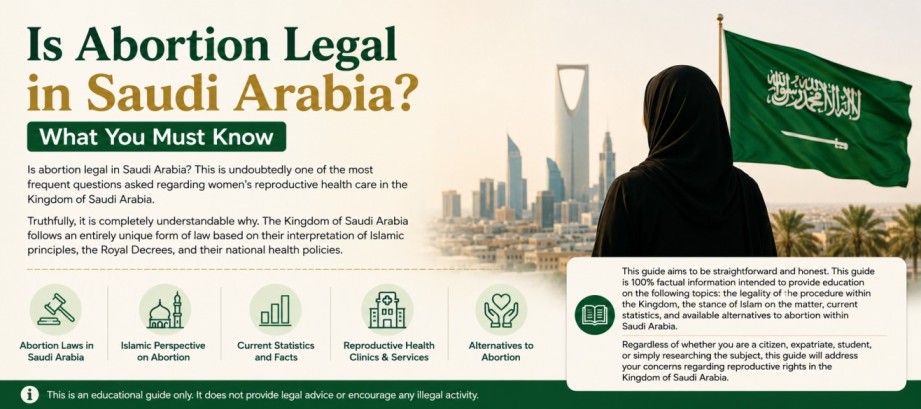
Is abortion legal in Saudi Arabia? This is undoubtedly one of the most frequent questions asked regarding women’s reproductive health care in the Kingdom of Saudi Arabia. Truthfully, it is completely understandable why. The Kingdom of Saudi Arabia follows an entirely unique form of law based on their interpretation of Islamic principles, the Royal Decrees, and their national health policies.
This guide aims to be straightforward and honest. This guide is 100% factual information intended to provide education on the following topics: the legality of the procedure within the Kingdom, the stance of Islam on the matter, current statistics, and available alternatives to abortion within Saudi Arabia. Regardless of whether you are a citizen, expatriate, student, or simply researching the subject, this guide will address your concerns regarding reproductive rights in the Kingdom of Saudi Arabia.
Explanation of the Saudi Abortion Act and Legal Regime
The Kingdom of Saudi Arabia does not have any document known as the “Saudi abortion act.” Rather, the laws in the Kingdom regulating abortions consist of two main bodies – the Islamic Sharia law and regulations of the Ministry of Health. As a result, Saudi Arabia is an extremely restrictive environment for abortion.
In clear words – abortion in Saudi Arabia is forbidden in almost all cases. It cannot be compared with other countries, where abortion is often treated as a matter of personal right. The Kingdom believes that protecting fetal life is its religious and legal duty.
However, abortion is allowed in some limited situations. These include:
• Existence of grave danger to the mother’s health – where there is a documented threat to the woman’s life if she were to
continue being pregnant.
• Severe, irreversible damage to the fetus – diagnosed before the fetal development reaches a certain period in the pregnancy.
• Abortion due to rape or incest – processed in an official manner, requiring proof of the incident.
It is important to note that even in such special circumstances, the process will not be easy for the woman. She will need to have her situation evaluated by a medical board. Additionally, in most cases, she will need the opinion of a religious leader or fatwa before moving forward with the procedure.
Why Is Abortion Not Legal in Saudi Arabia?
In order to get a clear understanding of why abortion is not allowed in Saudi Arabia, you have to know about the fundamental importance of religion in the country’s politics. The fact is that Saudi Arabia is not a secular country. Instead, it is an Islamic monarchy in which the Sharia is the highest law of the country.
It means that the issue of abortion should be seen more from the point of view of religious morality. In other words, the Saudi Arabian government has no obligation to allow abortion, as it would go against their policies and principles. Moreover, according to the laws of Saudi Arabia, any person who was involved in illegal abortion can be punished severely.
This can include the patient, the doctor who performed the procedure, or even the person who helped them somehow.
Is Abortion Allowed in Islam?
Perhaps one of the most often asked related questions is: “is abortion allowed
in Islam?” It is a more complex matter than the question itself suggests.
The Opinions of Islamic Legal Authorities Regarding Abortion
There is no single opinion given in Islamic fiqh regarding whether or not abortion is allowed. Various schools of Islamic
jurisprudence – Hanafi, Maliki, Shafi’i, and Hanbali madhabs – provide different opinions, especially with regards to early
pregnancies. They generally operate on the following premises:
• Before 40 days: Some authorities from the Hanafi school historically considered abortion allowable in severe conditions up to 40 days of pregnancy, but this is not a universally accepted stance.
• 40 – 120 days: Most of the authorities believe that abortion in such cases would be considered legal during this period when the situation is very grave for the mother.
• After 120 days (ensoulment): From this point onward, most of the Islamic scholars belonging to all the major schools agree that abortion becomes absolutely forbidden (haram), except when there is a serious danger to the life of the mother.
As Saudi Arabia is based on the Hanbali school of Islamic jurisprudence, which is the most conservative among the four main schools of jurisprudence, Saudi Arabia takes the strictest position regarding abortion. Therefore, the legal position in Saudi Arabia regarding abortion aligns perfectly with the religious standpoint.
Simply put: Islam does not allow abortion in general, and Saudi Arabia’s legal system is in complete harmony with its religious view.
Abortion Rate in Saudi Arabia
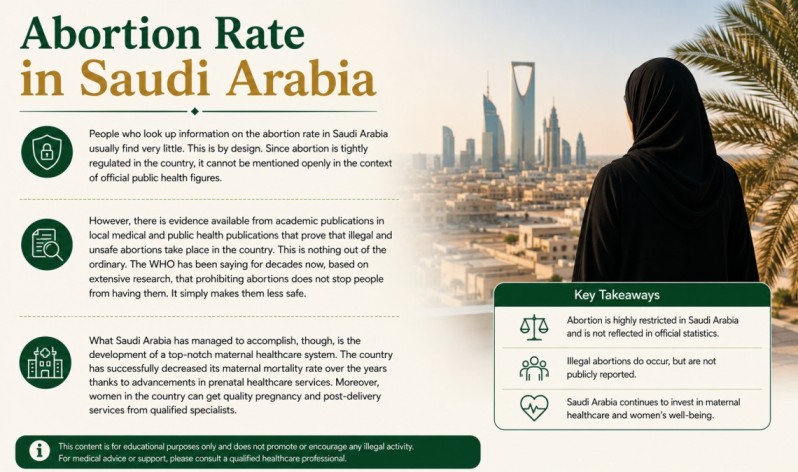
People who look up information on the abortion rate in Saudi Arabia usually find very little. This is by design. Since abortion is tightly regulated in the country, it cannot be mentioned openly in the context of official public health figures.
However, there is evidence available from academic publications in local medical and public health publications that prove that illegal and unsafe abortions take place in the country. This is nothing out of the ordinary. The WHO has been saying for decades now, based on extensive research, that prohibiting abortions does not stop people from having them. It simply makes them less safe.
What Saudi Arabia has managed to accomplish, though, is the development of a top-notch maternal healthcare system. The country has successfully decreased its maternal mortality rate over the years thanks to advancements in prenatal healthcare services. Moreover, women in the country can get quality pregnancy and post-delivery services from qualified specialists.
WHO Abortion Tips and Global Reproductive Health Guidance
Despite the restriction on abortion in some countries, WHO offers internationally respected recommendations concerning women’s reproductive health that still apply to all females. Tips for abortion offered by WHO, along with other guidelines on reproductive health, are regarded as the global standard in this field.
Main Recommendations of WHO Regarding Reproductive Health
As per WHO recommendations concerning reproductive and maternal health, every female, irrespective of her place of residence, has the right to:
• Receive unbiased reproductive health-related information to be able to make an informed decision together with her physician
• Obtain adequate prenatal care beginning with the first trimester of pregnancy
• Receive postpartum care to minimize maternal and infant mortality rates
• Get counseling on family planning delivered by certified medical specialists
• Undergo proper medical management of pregnancy-related issues, such as miscarriage and ectopic pregnancy
• Obtain mental health services as part of women’s health services
• Be treated respectfully and decently by healthcare specialists
In the Saudi Arabian case, however, the principles outlined by WHO are applied through the lens of national legislation. In this regard, women who need reproductive health care services are obliged to make use of the licensed healthcare institutions, but, at the same time, the standards described above also apply there.
Abortion Specialist in Saudi Arabia: All You Should Know
For anyone seeking out an abortion specialist in Saudi Arabia, what he/she actually wants to find is a gynecologist/obstetrician that would assist him/her in pregnancy problems. Here is one crucial thing to know without which you will be misled: in Saudi Arabia, there is no legally operating medical provider that performs any abortions on its own choice.
Here are the services provided by licensed ob-gyns in Saudi Arabia:
• Prenatal and antenatal care
• Management of high-risk pregnancy
• Miscarriage management and other types of pregnancy loss
• Obstetric emergency care
• Family planning and fertility consultations
• Postpartum care services
Should you have some issues with your pregnancy, seek help through the official channels only. Try no to contact anybody else – that would be both illegal and dangerous for your health.
Saudi Health Advice and List of Reproductive Health Care Centers
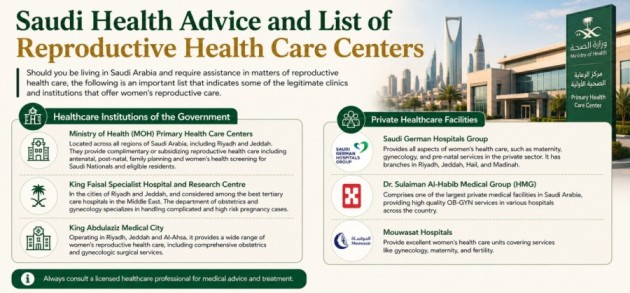
Should you be living in Saudi Arabia and require assistance in matters of reproductive health care, the following is an important list that indicates some of the legitimate clinics and institutions that offer women’s reproductive care.
Healthcare Institutions of the Government
The primary health care centers of the Ministry of Health (MOH) are located across all regions of Saudi Arabia, including Riyadh and Jeddah. They provide complimentary or subsidizing reproductive health care including antenatal, post-natal, family planning and women’s health screening for Saudi Nationals and eligible residents.
King Faisal Specialist Hospital and Research Centre – in the cities of Riyadh and Jeddah – is considered among the best tertiary care hospitals in the Middle East. The department of obstetrics and gynecology specializes in handling complicated and high risk pregnancy cases.
The King Abdulaziz Medical City, operating in the cities of Riyadh, Jeddah and Al-Ahsa provides a wide range of women’s reproductive health care, including comprehensive obstetrics and gynecologic surgical services.
Private Healthcare Facilities
The Saudi German Hospitals Group provides all aspects of women’s health care, such as maternity, gynecology, and pre-natal services in the private sector. It has branches in Riyadh, Jeddah, Hail, and Madinah.
Dr. Sulaiman Al-Habib Medical Group (HMG) comprises one of the largest private medical facilities in Saudi Arabia, providing high quality OB-GYN services in various hospitals across the country.
The Mouwasat Hospitals provide excellent women’s health care units covering services like gynecology, maternity, and fertility.
In a Reproductive Health Emergency
If you are in danger of losing your baby due to an emergency condition during pregnancy — for example, massive bleeding, excruciating abdominal pain, symptoms of miscarriage, or any other complications — you should visit the closest emergency department at once. According to Saudi laws, a doctor or paramedic is required by law to render any kind of assistance if it is necessary to save your life during such emergencies.
Frequently Asked Questions (FAQs)
Question 1: Is abortion legal in Saudi Arabia?
No. Is abortion legal in Saudi Arabia? The answer to that question is negative because it is only legal in some exceptional medical instances under Saudi laws and Islamic laws as well.
Question 2: Is abortion legal in Islam?
No. Most Islamic scholars have made it clear that abortion can only be acceptable in the event of real medical emergencies, especially in early pregnancies not exceeding 120 days. Beyond this period, scholars have declared abortion to be haram.
Question 3: What is the Saudi abortion law?
In Saudi Arabia, there is no specific abortion law. This abortion act includes Islamic Sharia Laws and the ones given by the Ministry of Health in Malaysia, making abortion possible only in some justified cases.
This abortion act includes Islamic Sharia Laws and the ones given by the Ministry of Health in Malaysia, making abortion possible only in some justified cases.
Question 4: Why is abortion banned in Saudi Arabia?
This is because Saudi Arabia operates on Islamic Sharia laws. In particular, the law followed by Saudi Arabia is the Hanbali madhab, which is the most conservative in terms of allowing abortion.
Question 5: What is the abortion rate in Saudi Arabia?
Statistics are confidential, but academic studies show that illegal abortions do happen. However, Saudi Arabia has an excellent system of maternal healthcare services to assist women within legal medical procedures.
6: Are there abortion specialists in Saudi Arabia?
There are no professionals authorized to perform elective abortions. Qualified obstetricians-gynecologists deal with pregnancy issues according to law. Visit hospitals under Ministry of Health, King Faisal Specialist Hospital, or any licensed private clinics.
7: What are WHO abortion tips for reproductive health?
The WHO guidelines cover quality antenatal care, family planning advice, safe management of complications, psychological assistance, and proper information on reproductive health services consistent with local laws.
Q8: What reproductive care centers operate in Saudi Arabia?
Some of the centers include MOH Primary Health Care Centers, King Faisal Specialist Hospital, King Abdulaziz Medical Center, Saudi German Hospitals, HMG Hospitals, and Mouwasat Hospitals throughout principal Saudi Arabian cities.
Q9: Are expats allowed to use reproductive services in Saudi Arabia?
Yes, expats have access to private hospitals such as Saudi German Hospital and HMG. Emergency reproductive healthcare is available by law for anyone who needs it. Always look for official healthcare practitioners.
Q10: In the event of an emergency pregnancy in Saudi Arabia, what should you do?
Visit the closest hospital and go straight to the ER. By law, emergency maternity healthcare services must be provided in all critical cases. Consult a qualified OB-GYN – no home treatment.
Conclusion: Explanation “Is Abortion Legal in Saudi Arabia?”
We will sum up everything we have learned. Now that you know all the details about Saudi Arabia’s laws concerning abortion, you may wonder, is abortion legal in Saudi Arabia? No, the short and precise answer is that abortion is not legal in Saudi Arabia except under specific circumstances that have been reviewed by health and religious authorities for approval — namely, if there is a real danger to the life of the mother or significant fetal anomalies.
Saudi Arabia’s abortion law is based on Islamic Sharia law following the principles of Hanbali law. Saudi Arabia makes abortion illegal for various reasons; however, these reasons are directly related to the country’s religious nature and values. They cannot be considered purely political issues.
If you are seeking help for reproductive health issues in Saudi Arabia, there is only one answer: seek help through the officially recognized healthcare system. The country has spent a lot on developing maternal and female health facilities, and those working under the system are the most reliable sources. Contact us Dr. Marry Visit website or Call now: +639537486940
The above piece is purely educational and informational. Kindly consult a professional healthcare expert in any personal health advice.
Seeking Reliable Reproductive Health Information?
Explore Abortion Gamot – your source for reproductive health education, family planning tips, and women’s well-being resources around the globe.
Got Questions? Get In Touch With Us at +639537486940
This article is provided solely for educational and informative purposes only. It should not be taken as professional advice of any kind whatsoever. Always seek licensed professional assistance from qualified experts.
Note: Don’t change keyword phrase: Is abortion legal in Saudi Arabia, abortion specialist saudi