
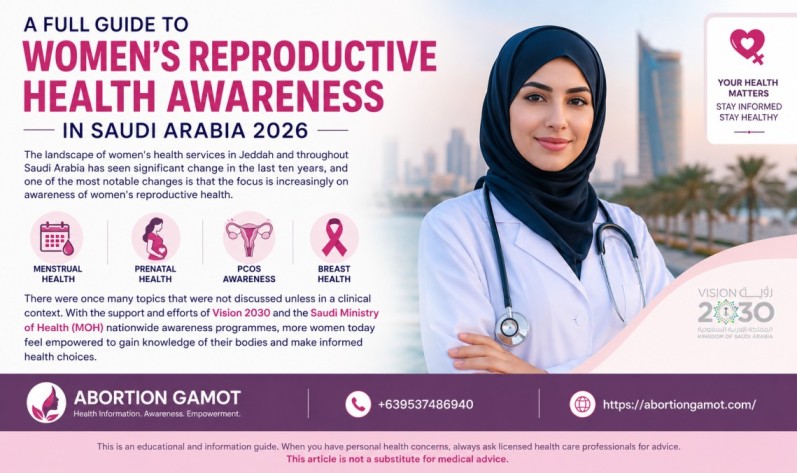
The landscape of women’s health services in Jeddah and throughout Saudi Arabia has seen significant change in the last ten years, and one of the most notable changes is that the focus is increasingly on awareness of women’s reproductive health. There were once many topics that were not discussed unless in a clinical context, such as menstrual health, prenatal health, PCOS, and breast health. With the support and efforts of Vision 2030 and the Saudi Ministry of Health (MOH) nationwide awareness programmes, more women today feel empowered to gain knowledge of their bodies and make informed health choices.
This is an educational and information guide. When you have personal health concerns, always ask licensed health care professionals for advice. This article is not a substitute for medical advice.
Why Reproductive Health Awareness Matters for Saudi Women
Let’s begin at the beginning. Reproductive health, according to the definition of the World Health Organization (WHO), is not merely the lack of reproductive disease, but rather a state of optimal physical, mental and social health in all areas of reproductive function. It’s for all things period, hormonal health, pregnancy, birth, breastfeeding and more.
According to Article 4 in the Saudi Health Law, the Ministry of Health has a special responsibility to improve the health of mothers and children through health services and awareness raising programmes in Saudi Arabia. The MOH also has a special platform on its website (moh.gov.sa) to raise women’s health awareness, where women can find accurate health information provided by the government. The goal of these activities is to enable families to have healthy, safe marriages (particularly reproductive health to have safe pregnancies and deliveries).
The bad news: Saudi Arabia’s maternal mortality rate has fallen from 25 deaths per 100,000 live births in 1990 to 16 in 2020, and this downward trend is expected to continue going forward.The good news: Saudi Arabia’s maternal mortality rate has dropped from 25 in 1990 to 16 deaths per 100,000 live births in 2020, with the downward trend continuing into the future as part of the Saudi Arabia’s Vision 2030 healthcare reforms. This is actual groundbreaking progress. However, the first step to maintaining that progress is to be aware.
Understanding Your Menstrual Health
Menstrual health is an integral component of reproductive health, and one that is seldom openly discussed even in most societies and cultures including Saudi Arabia. King Saud University research found that while most taboos do remain around the health of menstruation, this is changing and women are seeking help in a more open way.
What is Normal Menstrual Cycle?
Normal periods occur between 21 days and 35 days and the bleeding period for a normal cycle is 2 to 7 days. But there is some difference in ‘normal’ amongst people. It’s important to know your own pattern so you can tell when it shifts.
When to seek medical attention
If you have any of the following symptoms, you should seek advice from a licensed gynaecologist:
Any periods not experienced for three months or longer (excluding periods during pregnancy)
Heavy bleeding — bleeding through more than one pad or tampon within an hour of using for several hours
• Painful cramps that disrupts functioning
• Bleeding between periods or after sex
• Throbbing or severe pain in the knee
These symptoms may be indicators of other conditions like PCOS, uterine fibroids, endometriosis or other thyroid disorders, which can be treated if diagnosed early.
MOH GuidanceSaudi Ministry of Health advises women to have regular gynae checks and not to take any incidence of change in their periods for granted. Go to moh.gov.sa or make an appointment at your local women’s health clinic or primary health centre. |
PCOS Awareness: a problem that affects a lot of Saudi women
Polycystic Ovary Syndrome (PCOS) is a hormonal disorder that affects reproduction in women and is one of the most common in reproductive age women worldwide and in Saudi Arabia. Many women suffer from symptoms for years and only get a diagnosis because of poor awareness, and its prevalence.
What is PCOS?
PCOS is a condition in which there is an overproduction of male hormones (androgens) in the ovary, which disrupts the normal ovulation process. It is usually discovered by a combination of:
• Missed periods, or periods that occur at irregular times.
• A higher risk of developing unwanted ovarian cysts and/or fibroids, which can cause symptoms such as unwanted cysts or fibroids on the ovary and/or significant thinning of the hair on the crown of the head Polycystic Ovaries on ultrasound.
PCOS and Fertility in Saudi Arabia
Studies conducted by Saudi medical institutions have shown that PCOS is highly related to Saudi women’s concerns regarding their fertility as well as other diseases such as insulin resistance, Type 2 diabetes mellitus and cardiovascular risk. PCOS was also one of the most frequent gynaecology clinic diagnoses for unmarried young women in Saudi Arabia, according to a study at King Abdulaziz Medical City.
What Can You Do?
Fortunately, PCOS is very manageable, particularly when diagnosed and treated early. Based on expert recommendations that are used in most hospitals in Saudi Arabia:
Lifestyle modifications are always recommended in PCOS, such as a healthy, balanced diet, regular exercise and weight control, which can make a big difference in symptoms and hormonal balance, even a 5-10% loss of body weight.
Medication that can be prescribed by a licensed endocrinologist or gynecologists’ can be used to control periods and manage hormone symptoms.
Fertility treatments are available at licensed Saudi hospitals and are available to women with PCOS who would like to conceive.
The first step in suspected cases of PCOS is to visit a licensed doctor in Saudi Arabia specializing in women’s health (Obstetrician and Gynecologists’ or OB/GYN) for hormone tests and ultrasound.
Preconception Health: Planning for a Healthy Pregnancy
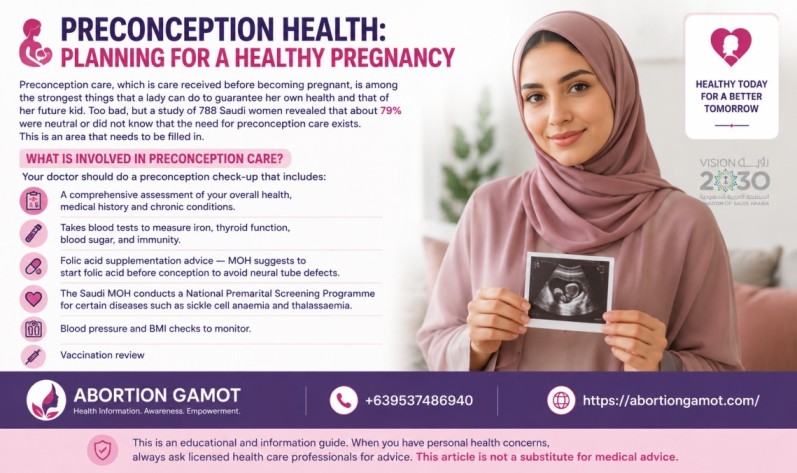
Preconception care, which is care received before becoming pregnant, is among the strongest things that a lady can do to guarantee her own health and that of her future kid. Too bad, but a study of 788 Saudi women revealed that about 79% were neutral or did not know that the need for preconception care exists. This is an area that needs to be filled in.
What is involved in Preconception Care?
Your doctor should do a preconception check-up that includes:
• A comprehensive assessment of your overall health, medical history and chronic conditions.
• Takes blood tests to measure iron, thyroid function, blood sugar, and immunity.
• Folic acid supplementation advice — MOH suggests to start folic acid before conception to avoid neural tube defects
• The Saudi MOH conducts a National Premarital Screening Programme for certain diseases such as sickle cell anaemia and thalassaemia.
• Blood pressure and BMI checks to monitor.
• Vaccination review
Saudi National Premarital Screening Programme
Saudi Arabia has a required premarital screening programme provided by the MOH. This process can also give couples medical information on the risk of passing along inherited diseases and options and guidance to plan a healthy family. It is an important reproductive health planning tool and is available in MOH facilities all over Jeddah and the Kingdom.
MOH Resource On the ministry of health website, there are resources such as a pregnancy timing calculator, breastfeeding cycle guide, and due date calculator. It also oversees the Mother and Child Health Passport System which tracks the health of mothers and children from before birth through early childhood. Visit: moh.gov.sa |
Expecting in Saudi Arabia — What to anticipate
Care provided during pregnancy (also known as antenatal care). The W.H.O. guidelines are that a low-risk pregnancy requires at least four antenatal visits and the Saudi MOH fully endorses this recommendation in all its health facilities.
When is the right time to start prenatal care?
The best time to make your first prenatal appointment is as soon as you discover you are pregnant— preferably before 10 weeks gestation. The sooner you register the sooner you and your baby will be cared for by your healthcare team.
What Happens at Prenatal Appointments?
• Pregnancy confirmation/ dating by ultrasound.
• Blood pressure, weight and urine monitoring are carried out.Blood pressure, weight and urine monitoring are done.
• These are available to test blood components such as the presence of gestational diabetes, anaemia and infectious diseases (HIV testing is mandatory for pregnant women in Saudi Arabia)
• Monitoring fetal growth and fetal heartbeat.
• Education and information on health and nutrition
• Screening for gestational diabetes mellitus (GDM) usually occurs between 24-28 weeks of pregnancy.
Gestational Diabetes — An Important Awareness Point
Gestational diabetes mellitus (GDM) is a condition that frequently occurs during pregnancy and studies in the Kingdom of Saudi Arabia reveal that the awareness of the risk factors for GDM are not so high in the community. If not detected, GDM can pose a risk to both mother and baby, therefore it is important to get regular checks during pregnancy. Factors that increase the risk are age, obesity, a family history of diabetes and lack of exercise.
Saudi women are able to attend their prenatal care at either a government MOH facility (which is free to Saudi nationals) or a private hospital. Expectant mothers are also able to create birth plans with their providers, such as preferences for the mode of delivery and who they would like to be present at the time of birth.
Breast Health Awareness, Cervical Health Awareness
Breast cancer is the most prevalent cancer among Saudi women. Breast cancer is the most common cancer of Saudi women.
Breast cancer is the most common cancer among females in Saudi Arabia. In response, the Saudi Ministry of Health has launched the Saudi National Breast Cancer Early Detection Programme offering free mammograms to all Saudi women over the age of 40. The MOH has been working with GE HealthCare in 2023 to introduce the ‘One Stop Breast Plus Diagnostic Pathway’ programme to reduce delays and improve the early diagnosis of breast cancer.
Early detection is critical. The prospects for treating breast cancer are much better if it is detected early. The good news is that you can lower your risk and increase your chances of early detection by:
• Practicing monthly self breast exam
• Regularly attending mammogram beginning at the age of 40 (free at MOH facilities to Saudi nationals)
• Seeing a doctor right away if you see any lumps, discharge from the nipples, changes in the shape of the breast or skin dimpling.
Cervical Health and Pap Smear Awareness
Cervical cancer is preventable if the changes that can lead to it are detected early enough. According to MOH, women should continue to get routine pap tests until they reach the age of 65 — every two years at least. A Pap test can be performed by a woman doctor or nurse in a clinical setting, is painless and simple, and can reveal abnormal cells in the cervix before they turn into cancer.
In addition to Pap testing, human papillomavirus (HPV) testing may be done to help better evaluate cervical health. Talk with your health care provider about this during your next exam at the women’s health clinic.
Key Reminder Saudi women over the age of 40 can get free breast cancer screening (mammograms) at MOH health facilities. Please note that an appointment can be made via the Mawid system, moh.gov.sa or the Seha virtual hospital platform. |
Women’s Rights in Healthcare — What the Law Says
An essential shift for women wanting care in Saudi Arabia: Women are no longer needed to have a male guardian (mahram) approve medical treatment or to make their own medical decisions. This reform in a big way enhances autonomy, accessibility and confidentiality for women in the Kingdom.
Pregnant women are also entitled to choose the healthcare provider where they receive follow-up care and/or delivery in Saudi Arabia, be it in public or private hospitals or clinics. Women have the right to:
• Be given correct and up-to-date information on their health status
• Access to counselling prior to, during and after pregnancy
• Access health care in the field in areas without access to medical facilities
• Access maternal and child health services without paying any fees at government facilities (for Saudi nationals)
Being aware of one’s rights are a component of reproductive health awareness. You have the right to receive respectful, confidential and professional health care from licensed health care providers.
Where to Access Reproductive Health Services in Saudi Arabia
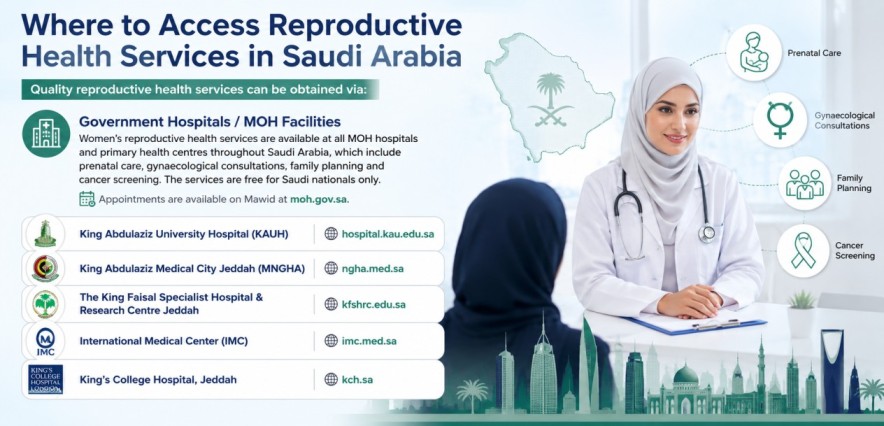
Quality reproductive health services can be obtained via:
Government Hospitals/MOH Facilities
Women’s reproductive health services are available at all MOH hospitals and primary health centres throughout Saudi Arabia, which include prenatal care, gynaecological consultations, family planning and cancer screening. The services are free for Saudi nationals only. Appointments are available on Mawid at moh.gov.sa.
The major departments in the hospital specializing in OBE and GYN are located in Jeddah.
King Abdulaziz University Hospital (KAUH) is located at hospital.kau.edu.sa.
King Abdulaziz Medical City Jeddah (MNGHA) — ngha.med.sa
The King Faisal Specialist Hospital & Research Centre Jeddah is located at kfshrc.edu.sa.
International Medical Center (IMC) is located at imc.med.sa.
King’s College Hospital, Jeddah, kch.sa
Women’s Health Clinics
Gynaecological and reproductive health consultations are also easily available at private women’s health clinics in Jeddah and other urban areas, which may have a shorter waiting period. Many are in community places that are easily accessible.
Virtual Healthcare
The MOH’s Seha Virtual Hospital offers AI-driven virtual health services and consultations, including for women’s health. This makes it simpler than ever to get expert advice at home.
Common Questions and Answers (CQAs)
Q1: In Jeddah, are there any women health services that are free?
Reproductive and maternal health services provided at all MOH hospitals and primary health centres are free for Saudi nationals, such as prenatal and postnatal care, breast cancer screening (mammograms for women aged 40 years and above). Expatriates pay applicable rates at government facilities, and have health insurance from their employers, with which they go to private clinics.
Answer: Q2. What should I look out for if I have PCOS?
Symptoms vary from irregular or missed periods, weight gain, excess facial or body hair, acne, and trouble conceiving. PCOS can be diagnosed using blood tests and ultrasound by a licensed gynaecologist. It is a treatable condition — get a check-up early.
Q3: At what stage should be the beginning of Prenatal Care in Saudi Arabia?
As early as possible — ideally before 10 weeks of pregnancy. The MOH recommends that, during low-risk pregnancy, a person should have at least four antenatal visits. Early booking equates to early monitoring, which will safeguard mother and baby. The facility can be booked from MOH facilities or any private hospital that you choose to book at.
Q4: Do the people in Saudi Arabia pay for breast cancer screening?
Yes. Mammograms are free for Saudi women over 40 as part of the national Breast Cancer Early Detection Programme offered by the MOH. This is available at MOH health facilities. There are also breast health clinics available in private hospitals that those opting for them can attend.
Q5: Should I have to visit a gynaecologist in Saudi with a guardian?
No. Saudi women are no longer required to have the permission of a male guardian (mahram) to get medical attention or take care of their health. You are entitled to make and attend appointments without any restrictions at any licensed hospital or women’s health clinic and have full confidentiality.
Q6: What is the Saudi MOH premarital screening programme?
The National Premarital Screening Programme is an obligatory programme from the Ministry of Health for screening of engaged couples for hereditary diseases such as sickle cell anaemia and thalassaemia. It offers medical counseling and assists couples to plan a healthy family. It is available at MOH facilities Kingdom-wide.
Q7: What is a Pap smear and should I have one?
Pap test is a basic screening for cancer of the cervix that assures the removal of cells from the cervix. The MOH suggests using a Pap test regularly for women until they are 65 years old, every two years or more often. It is a fast in-clinic test which can catch abnormal cells before they become more serious, at which point treatment is most effective.
How to locate a licensed women doctor in Saudi Arabia?
Check a doctor’s licence on the Saudi Commission for Health Specialties (SCFHS) registry via the web (scfhs.org.sa). Every obstetrician/gynecologist working in Saudi Arabia is required to be certified by SCFHS. Another option would be to check hospital websites or call to make a booking with a female specialist if you would like to.
Q9: What is gestational diabetes? How do they know if you have it?
Gestational diabetes (GDM) is a type of high blood sugar that occurs during pregnancy. It is monitored by a measurement of the blood glucose level, usually performed at 24-28 weeks. Obesity, high maternal age at delivery, and family history of diabetes. Regular prenatal care is essential for early detection of problems, thus keeping mother and baby safe.
Q10: Where does one get MOH Women Health resources in Saudi Arabia?
The Ministry of Health portal at moh.gov.sa has a designated women’s health page with content to educate people, list of services, appointment booking (Mawid), the due date calculator, pregnancy calculator, and the Mother and Child Health Passport System. Digital health consultations are also possible via the Seha Virtual Hospital.
Conclusion
Maintaining your reproductive health is one of the greatest investments you can make in your overall health. Whether it’s knowing your menstrual cycle, managing PCOS, having regular prenatal check-ups or checking your breasts — every choice you make is a healthy one for you and your family.
The Saudi Ministry of Health and Vision 2030 have led Saudi Arabia’s healthcare system to significant progress in increasing women’s autonomy, improving the quality and sophistication of women’s health services, and making them more available to women in Jeddah and across the country. A health care system that is truly “favoring” women is marked by the following: Free breast cancer screening, nationwide prenatal care programmes and removal of the guardian requirement for medical decisions.
Looking to get started next?
For more information on women’s health visit the MOH women’s health portal, to make an appointment at the Mawid, or to take a consultation via the Seha Virtual Hospital, from the comfort of your home. If you need special treatment, seek care from the OB/GYN department of the local licensed hospital or clinic. Your health is important – and help is ready. Visit our website for any helo or contact Dr.Marry
Important DisclaimerThe information in this article is for educational and informational purposes only. It is not intended to be medical advice, diagnosis or treatment. Any health related issues should be addressed with a qualified health care provider. The Saudi Commission for Health Specialties (SCHS) and the Ministry of Health are the regulatory entities of all medical services in Saudi Arabia. |