
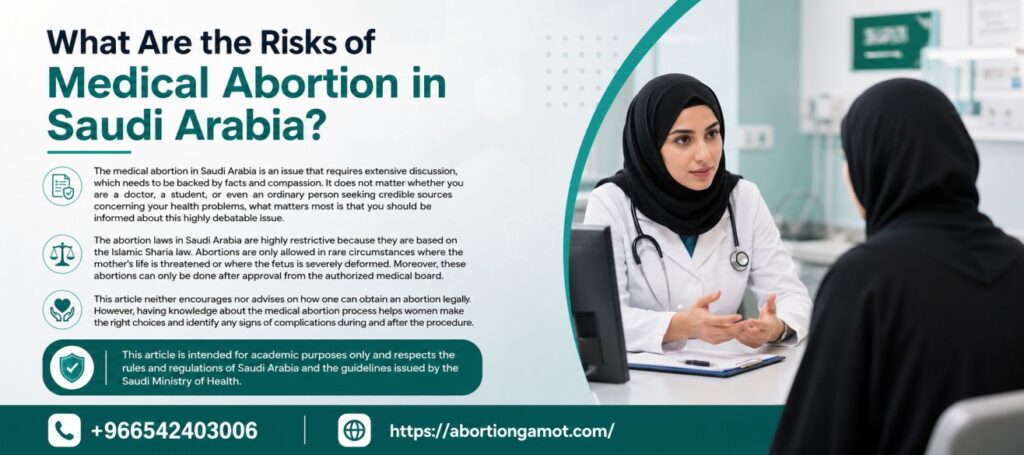
Knowledge of the Legal Environment in Saudi Arabia
Prior to discussing medical abortion hazards, it is vital to have an understanding of the legal environment within which this topic operates. In Saudi Arabia, its healthcare system as well as its laws are inseparably related to Islamism and Sharia laws. According to Hai’at Kibar al-Ulama (Saudi Arabia Council of Senior Scholars), the use of abortion is not permissible unless there is a known, documented medical emergency case.
Main facts about the legality of abortion every citizen should be aware of include the following:
• Medical abortion can only be performed before 40 days of pregnancy during documented extreme medical emergencies.
• The period of 40-120 days will require termination of pregnancy approval from the committee of the licensed hospital.
• After 120 days, only direct saving of the mother’s life through abortion is allowed, based on the specialists’ opinion.
• All the mentioned cases involve consent, documentation of a specialist, and permission from the committee of specialists.
• Performing abortion without these legal measures results in harsh penalties for the perpetrators.
In case of any reproductive health concerns, women are recommended to seek the help of qualified specialists working in officially approved governmental hospitals or clinics.
 Remember: This article completely abides by Saudi Arabia’s laws. It provides information purely for educational reasons only.
What is a Medical Abortion? A Clinical Perspective
A medical abortion is a non-surgical method of ending a pregnancy using specific medications — typically a combination of mifepristone and misoprostol, or misoprostol alone. These medications work by blocking pregnancy hormones and causing uterine contractions that expel the pregnancy naturally from the body.
Globally, the World Health Organization (WHO) recognizes medical abortion as a clinically safe and effective procedure — but only when conducted under appropriate, qualified medical supervision. Medical abortion safety depends entirely on proper patient screening, accurate gestational age assessment, correct dosing protocols, attentive supervision, and timely follow-up care.
It is absolutely critical to note that in Saudi Arabia, the administration of such medications outside of a licensed, formally approved medical setting is both illegal and extremely dangerous. Self-administering these medications without a physician’s guidance can lead to life-threatening complications.
Medical Abortion Risks: Everything You Should Be Aware Of
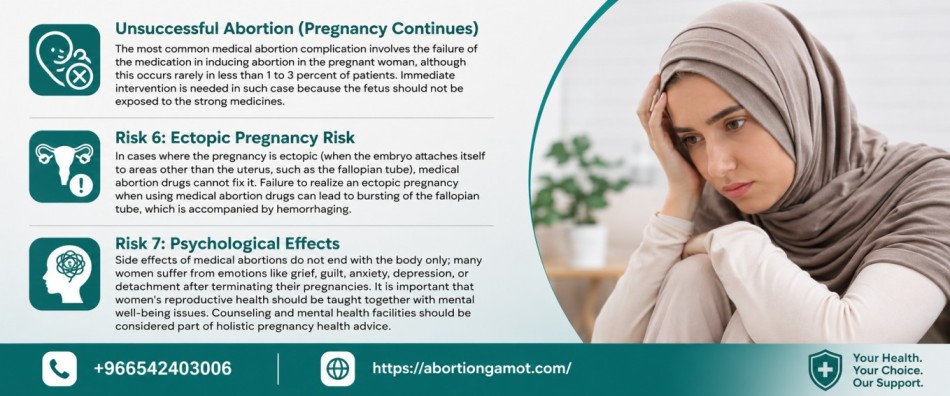
Knowledge about medical abortion risks is among the most vital aspects when educating women on their reproductive rights. While under the supervision of professionals worldwide, there is no doubt that these risks still exist, and each patient should be made aware of them.
Medical Abortion Risk #1: Incomplete Abortion
Among the most common medical abortion complications is the partial abortion or retention of the pregnancy tissues within the uterus. It may cause severe infections in the uterus, excessive bleeding, and ultimately, surgery is required (D&C procedure). The percentage of this occurrence is estimated to be about 2 to 5% in all medically supervised cases.
Medical Abortion Risk #2: Hemorrhagic Bleeding
Bleeding is a normal aspect of the process; however, hemorrhagic bleeding is considered a serious risk during a medical abortion. If you bleed heavily for more than two sanitary pads per hour continuously, this is an emergency case where you need to visit your hospital as soon as possible.
Risk 3: Infections and Sepsis
The most common medical abortion complication is infection of the uterus, which could develop into sepsis in a matter of minutes if not treated immediately. The symptoms that could indicate the development of infections from medical abortion include fever over 38°C, odor from vaginal discharge, intense abdominal pain, and general ill health.
Risk 4: Intense Abdominal Pain
Although slight to moderate abdominal pains are to be expected during the process, intense or worsening abdominal pain that cannot be relieved by medication is a serious medical abortion complication. It may point to some other complications such as the presence of ectopic pregnancy, infections, and the failure of medical abortion.
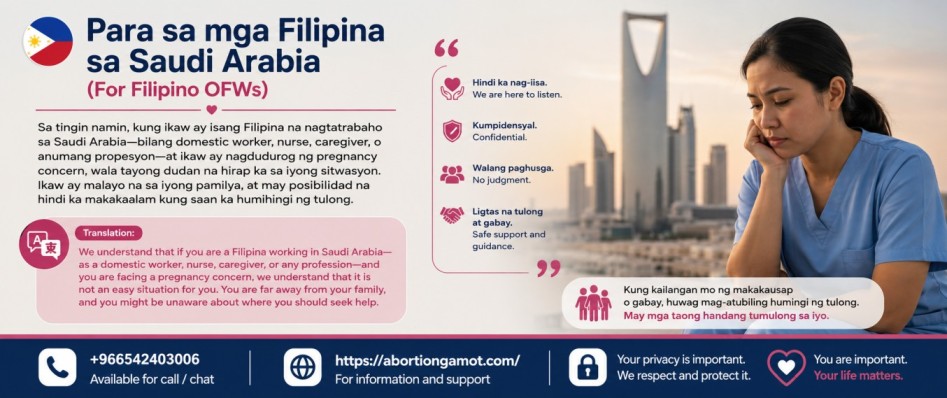
Para sa mga Filipina sa Saudi Arabia (For Filipino OFWs)
Sa tingin namin, kung ikaw ay isang Filipina na nagtatrabaho sa Saudi Arabia—bilang domestic worker, nurse, caregiver, o anumang propesyon—at ikaw ay nagdudurog ng pregnancy concern, wala tayong dudan na hirap ka sa iyong sitwasyon. Ikaw ay malayo na sa iyong pamilya, at may posibilidad na hindi ka makakaalam kung saan ka humihingi ng tulong.
(Translation: We understand that if you are a Filipina working in Saudi Arabia—as a domestic worker, nurse, caregiver, or any profession—and you are facing a pregnancy concern, we understand that it is not an easy situation for you. You are far away from your family, and you might be unaware about where you should seek help.)
Your Rights as a Filipino OFW in Saudi Arabia
• Ang kasalukuyang trabaho mo ay walang kabalbal sa iyong karunungan na makakuha ng medical assistance.
• Nagbibigay-daan ka pa ng hakbang pag-usbong kahit na matalo ka ng iyong employer.
• May proteksyon ka sa batas RA 10022.
• Ang POLO (Philippine Overseas Labor Office) sa Saudi Arabia ay nagbibigay-daan kang humingi ng tulong.
• Kaya mong umibig kay Philippine Embassy para sa iyo.
POLO & Philippine Government Agencies in Saudi Arabia
• POLO Riyadh – Philippine Overseas Labor Office | polo.riyadh@dole.gov.ph
• POLO Jeddah – polo.jeddah@dole.gov.ph
• Philippine Embassy Riyadh – riyadh.pe@dfa.gov.ph | Tel: +966-11-4820-092
• Philippine Consulate General Jeddah – Tel: +966-12-667-5713
• OWWA (Overseas Workers Welfare Administration) – owwa.gov.ph | Hotline: +632-8891-7601 (24/7)
• DFA Assistance to Nationals (ATN) – atis@dfa.gov.ph
Mga Ospital sa Saudi Arabia na May Filipino Doctors/Staff
• King Faisal Specialist Hospital, Riyadh – Filipino nursing staff and multilingual assistance
• Dr. Sulaiman Al Habib Medical Group – Has Filipinos in their various hospitals
• Saudi German Hospital Jeddah & Riyadh – Recognized for treating foreign patients
• Mouwas
Praktikal na Payo para sa OFWs
• Huwag mag-self medicate. Do not self-medicate. It’s dangerous and it’s illegal in Saudi Arabia.
• Tumakasagot sa POLO o Philippine Embassy kung kailangang makita kang tulong. Contact POLO or the Philippine Embassy immediately when you require assistance.
• Kumpidensyal ang lahat ng medikal na konsultasyon. Medical consultations are all confidential.
• Kung may problema ka sa kaligtasan mong kinakaharap, tawagan ang Saudi Emergency hotline: 911. In case you find yourself in danger, call the Saudi Emergency number: 911.
• Reproductive health payo: Visit Abortion Gamot
 Ito’y importante para sa mga OFWs: Hindi ka nakaalone. Ang gobyerno ng Pilipinas ay may sistema para sa mga OFWs na nakakaharap sa mahigpit na sitwasyon buong panahon kanilang nakalagay sa ibang bansa. Kontakin ang POLO, Philippine Embassy, or OWWA para sa kaakibatang makatulong sa iyo at hindi makadikit sa iyo.
Mga Importante na Tagalog Health Terms
• Pagbubuntis — Pregnancy
• Pagpapalaglag — Abortion (illegal in Philippines and heavily restricted in Saudi Arabia)
• Medikal na Payo — Medical Advice
• Ospital — Hospital
• Doktor / Manggagamot — Doctor
• Emergency — Emergency (same in Tagalog)
• Tulong — Help
• Kumpidens
Frequently Asked Questions (FAQ)
Q1: Is Medical Abortion Legal in Saudi Arabia?
In Saudi Arabia, medical abortion is legal if there is evidence of a documented medical emergency situation. The process must be sanctioned by the medical committee of the concerned hospital, based on Islamic law. Otherwise, it is illegal. Please contact a professional licensed doctor for further information.
Q2: What Are the Common Medical Abortion Risks?
The major medical abortion risks are the possibility of an incomplete abortion, excessive hemorrhaging, severe infections of the uterus, failure of the process, and complications due to an ectopic pregnancy. All such risks can lead to severe and possibly fatal health conditions. It is imperative that you seek medical supervision at all times.
Q3: What Are the Common Side Effects?
Medical abortion side effects may be cramps, bleeding, nausea, vomiting, shivering, and tiredness. In case you find yourself in difficulties, such as uncontrolled bleeding, fever, or increased pain, it would be best to visit the nearest accident and emergency unit.
Q4: How long will recovery last?
Recovery from a medical abortion usually lasts one to three weeks. The bleeding becomes lighter over time, and it is important to have an examination in order to ensure that the process was completed fully, and to rule out complications such as retention of tissue or infections.
Q5: When do warning signs require emergency treatment?
Warning signs for a medical abortion requiring emergency treatment include fever greater than 38°C over a period of 24+ hours, soaking two pads an hour, foul discharge, lack of bleeding within 24 hours, and constant painful cramps. Seek immediate emergency attention at the hospital.
Q6: What is the importance of medical supervision?
Importance of medical supervision is the patient’s safety in all aspects. Correct dosage, screening, proper monitoring, and being able to perform surgeries if necessary are key elements to avoid potential complications. An unsupervised medical abortion is not only dangerous, but also illegal in Saudi Arabia.
Q7: Where to get reproductive healthcare in KSA?
Contact the Saudi MOH at 937, or visit King Faisal Specialist Hospital, King Fahad Medical City, or any other MOH Primary Healthcare Centre. Reproductive healthcare is provided in all OB-GYN Departments legally and confidentially.
Q8: Is future fertility affected by medical abortion?
With adequate guidance, there will be no fertility issues for the woman after the medical abortion process. However, possible complications that may arise without adequate care may affect future fertility.
Q9: Which emotions are considered normal?
Grief, sadness, guilt, anxiety, emotional numbness – these are just some of the emotions that a woman experiencing the loss of her pregnancy will experience. In addition to reproductive health, women’s education must include their mental health too. Contact the Saudi mental health hotline by dialing 920033360 or consulting a counselor.
Q10: Reliable health education sources?
To receive proper reproductive health education, refer to https://abortiongamot.com. It is an online source that provides reproductive health education exclusively for women.
Conclusion: Education Is the Basis of Safety
Medical abortion in Saudi Arabia is still a controversial, intricate, complicated matter, particularly for Filipino OFWs who are abroad in another country, away from their families. The purpose of this article is to offer factual and ethical education on health — all within the legal framework and medical guidelines of Saudi Arabia and Islam.
Knowledge about the dangers of medical abortion, medical abortion side effects, medical abortion complications, and the critical role of medical supervision allows individuals to make proper, responsible decisions that will benefit them.
Reproductive health education among women is vital. It is not an elective but a necessity. If you are a Filipino OFW in Riyadh, Jeddah, or other parts of Saudi Arabia, or researching medical abortion for academic purposes or personal knowledge, do not hesitate to consult your doctor first before making any medical decisions.
To all Filipina overseas workers – ikaw ay hindi nag-iisa. You are never alone. There are resources to turn to. Be safe, be informed, and seek professional help.
Always keep in mind that there are three key ingredients to reproductive health safety, and these include early detection, swift action, and professional guidance. Feel free to distribute this informative material wherever it could be helpful.
Seeking Advice? Contact MOH Helpline at 937 (24/7), or Mental Health at 920033360
Get your trustworthy information on reproductive health here at Abortion Gamot: https://abortiongamot.com
IMPORTANT DISCLAIMER
This publication serves only as an informative piece. It is neither a medical recommendation nor a legal advice. No procedures mentioned herein are endorsed by the authors outside of the legal framework. All facts presented herein strictly adhere to the laws and ethical considerations of the Kingdom of Saudi Arabia and its Islamic medical practice. It is highly recommended that readers consult professional healthcare providers for all personal health matters. The website Abortion Gamot (abortiongamot.com) posts this article for public health education.
Medical Contributor: Dr. Mary Santos, MD – OB-GYN Specialist, Philippines
Released by Abortion Gamot | abortiongamot.com